What Is the Displacement From the History Classroom to the Art Room?
The fight for equal rights, basic rights similar equal education, were brought to the forefront of America's attention during the African American Civil Rights move of the 1950s and 60s. Merely as we saw in the Civil War-era piece of work The Lord is My Shepherd, which depicted a newly emancipated black man reading the Bible, here as well, in the depiction of African Americans reading in a library we are reminded that the ability to read, to educate oneself is the ultimate form of empowerment and best tool with which to combat oppression. The two African Americans shown in a cramped confined infinite are visually and literally restricted, both past horizontal barriers and by their status as minorities in the 1950s. The work alludes to the lack of opportunities and education open to blacks. The landmark conclusion of the Supreme Court in the case Brown v. Board of Education in 1954 helped brainstorm to heal discriminatory divides. The courtroom declared dissever public schools unconstitutional, stating that "separate educational facilities are inherently unequal."
Download a Teaching Poster PDF of The Library
Activity: Detect and Interpret
The Children
Artists make choices in communicating ideas. Charles White is a leading African American artist of the twentieth century. He is all-time known for the masterful drawings he created throughout his career. What message is Charles White trying to convey in this drawing? What tin can we learn about African American life post-obit the conclusion of World State of war II through this artwork? Observing details and analyzing components of the artwork, and then putting them in historical context, enables the viewer to interpret the overall message of the artwork.
Observation: What practise you run into?
What are the figures looking at? What could they exist thinking about?
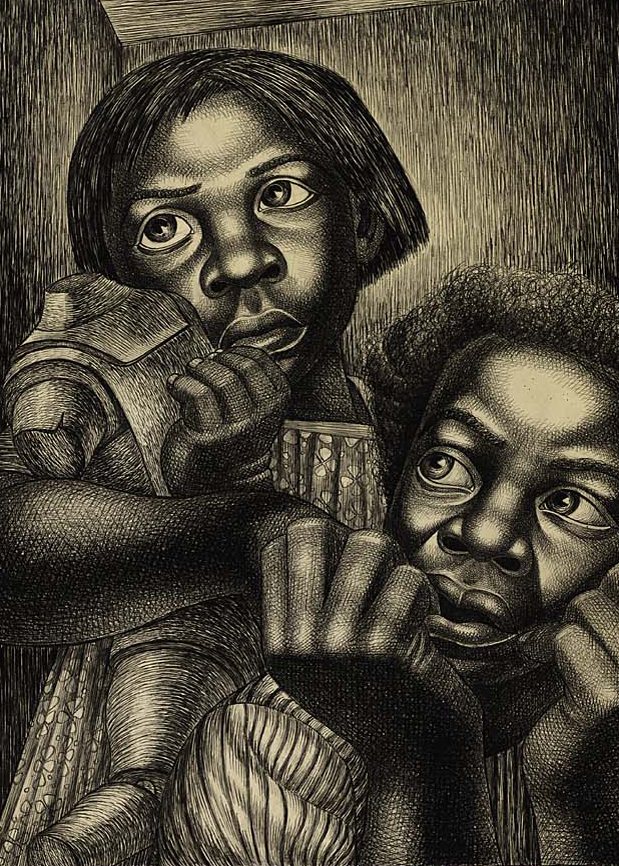
In this intense composition, two figures stare out of a narrow window, both gazing upward. Charles White'due south cartoon exudes an anxious, uneasy mood. He carefully renders the figures so that viewers identify with their apprehension. The African American girl in the background clutches a doll hoping it can provide her with solace. The doll's headless and armless body serves as a symbol of the daughter'south thwarted ambition and lack of opportunity. She looks outside the window, perhaps wondering what is to become of her. The figure in front of her—perchance an older brother—holds upwards large, powerful hands to his face, another sign of worry. He looks out the window, speculating about her future in a world filled with adversity for people of their race. Although they inhabit the same space and glance in a like direction, they seem discrete from i another, as if their worries isolate them. Compressing the figures behind the window'due south flat surface, White makes the pair'due south agitation and forlornness palpable. The artwork captures the mail service-World War II anxieties and adversity faced by black Americans, expanded on by black veterans returning home to a world defective in opportunity.
How does the artist create tension?
The figures are locked tightly in a cropped infinite, their motility cramped past the edges of the window. The lack of depth behind them, along with the restrictive horizontal bars in forepart of them, further hem them in physically. It is conceivable that the lives of these two figures are likewise barred by restrictions imposed on African Americans during the 1950s; restrictions such as segregated public facilities and a lack of opportunity in education and employment. The drawing is made with thousands of fine lines and crosshatching, that infuse the composition with motion and tension. For White, the late 1940s and early 1950s were a deeply anxious time. As a left-wing artist who associated with progressives and members of the Communist Party, he felt the constant threat of political persecution, especially after the McCarran Deed of 1950 criminalized activities perceived to be destructive.
Interpretation: What does it mean?
While White'due south art may convey some of his personal anxieties, he relates his work to social problems of particular importance to African Americans, seeing himself as a "spokesman for my people." Around 1950, when White created this drawing, school desegregation had become the prevailing civil rights issue for many African American families. Returning black WWII veterans who had and risked their lives serving their country, at present found that they had to send their children to segregated and terribly inadequate schools. This event may also accept been specially meaning to White, who married and began his own family that year. Since the 1930s, thousands of African Americans had joined protests against school segregation. Yet in 1950, civil rights leaders used new tactics to show that segregation was not but unfair but likewise psychologically damaging to blackness children. To provoke legal battles, these leaders encouraged blackness children in certain communities to endeavor to nourish all-white schools, knowing they would exist turned away. 5 key cases began to brand headlines in 1950 and culminated in the 1954 landmark Supreme Courtroom decision, Brown v. Lath of Education, which ruled school segregation illegal. White's drawing may non be a straight commentary on the result of school desegregation, yet by portraying two African American children within a bars, tense space, White seems to annals the psychological torment African American families endured during the era of segregation.
Download (PDF)
The Library
Artists brand choices in communicating ideas. What data can nosotros learn nearly the African American experience in Harlem from this painting? What clues does Jacob Lawrence give united states? Observing details and analyzing components of the painting, and then putting them in historical context, enables the viewer to interpret the overall bulletin of the work of art
Observation: What practice you run across?
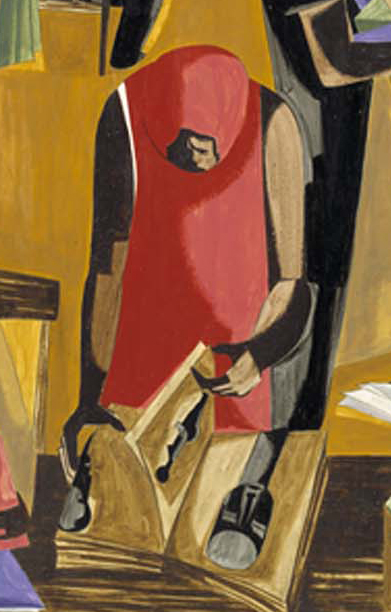 How would you describe the setting and the people shown in this painting?
The books, desks, and people reading tell the states that the scene depicted is in a library. A group of African American men and women sit down and stand in a brightly reading room. They are not speaking to one some other or looking around the room – they are completely absorbed in their reading, seemingly oblivious to the other people around them. The standing figure in the foreground, looking through a book of African sculpture, may represent the creative person, Jacob Lawrence, himself. Libraries played a critically important function in Lawrence'south artistic development, offering him a facility where he could acquire about the lives of civil rights leaders and abolitionists such every bit John Brown, Harriet Tubman, and Frederick Douglass, all of whom became subjects of Lawrence's work.
What is the mood of the artwork? How does the artist reach this?
The bright colors and patterns suggest that the library is a busy, simply happy place to be. The bright, flat colors and decorative patterning in The Library are likely nuanced references to African kente textile. It first appeared in Ghana in the seventeenth century and has traditional ceremonial usage. The word kente means "handbasket" or "woven textile" in the Akan or Ashanti dialect, and is made of narrow strips of fabric woven together to form patterns. The designs, colors, and patterns each have their own special meanings and stories. During the 1960s the brilliant colors and patterns of kente cloth were appropriated as an emblem of the Black Pride movement – wearing kente cloth was, and notwithstanding is today, worn by African Americans as a representation of pride in ane'south ancestors and African heritage.
Interpretation: What does information technology mean?
This colorful view of a crowded reading room depicts readers captivated in enquiry at the 135th Street Library in New York City's Harlem neighborhood. The library, now the Schomburg Center for Inquiry in Blackness Culture, was frequented by artist Jacob Lawrence as a young man. Lawrence, who grew up in Harlem, recalled that in high school, black culture was "never studied seriously like regular subjects," so he spent a lot of his time at the 135thursday Street Library and museums to teach himself about black culture and history.
Painted 3 years afterwards school de-segregation in 1957, The Library serves to remind African Americans of the importance of education and in remembering and preserving their African history and culture in the wake of school de-segregation. During the Civil Rights Motility, libraries, similar the 135th Street Library the creative person frequented as a boyfriend, provided safe learning spaces for African Americans to study their history and culture when it was non part of the curriculum taught in integrated classrooms throughout the country.
Historical Groundwork
After the War: Blacks and the G.I. Bill
"I am a human being of substance, of mankind and bone, fiber and liquids – and I might fifty-fifty be said to possess a heed. I am invisible, understand, simply because people refuse to run across me." – Ralph Ellison, Invisible Man, 1952
For many blackness American veterans, coming back dwelling after the war became a period of difficult transition. The handling blacks received in Europe was much different than the racism and prejudice they had experience in America. In Europe they had been treated just like any other soldier, the colour of their skin was non a consideration. One young soldier commented, "Had the ten months I spent in France been all in vain? Were those white crosses over the dead bodies of those dark-skinned boys lying in Flanders fields for cypher? Was republic simply a hollow sentiment? What had I washed to deserve such treatment?" This fundamental shift in treatment raised promise and expectation that things would be different one time they returned to American soil. A metaphorical reading of Untitled by African American artist Charles White suggests that the 2 African American figures are barred from participating in the society which they are able to view from their window. The ii boards across the narrow window restrict the two figures within the space of the limerick. This artwork, created in 1950, captures the anger, unease, and sense of displacement that would feed the civil rights motion of the late 1950s and 1960s.
The effects World War Two had on the lives of African Americans were viewed both as successful and unsuccessful. After the state of war all branches of the military committed to review their policies for racial integration, all the same racism and prejudice ran rampant in many areas of civilian life. Some blackness soldiers did not find their service to exist a satisfactory experience yet others noted that they gained skills, an education and the chance to feel life outside of the United States. When they returned dwelling house, the M.I. Bill , or the Servicemen's Readjustment Human activity of 1944, sought to provide returning service members with many benefits. Among these benefits were low-cost mortgages, loftier school or vocational education, payments for tuition and living expenses for those electing to attend college, and low-interest loans for entrepreneurial veterans wanting to offset a business. These benefits were open up to all veterans, including those honorably discharged, who had served at least 120 days of agile duty (combat duty was non required). The bill not only helped private service members, but also stimulated long-term economic growth. Though the law was accounted a political and economic success, there was 1 segment of veterans who were denied many of the pecker'due south benefits – African Americans.
1 of the more important benefits that African American service members were unable to take advantage of were low-toll mortgages. In theory, this do good allowed all veterans to buy homes in the quickly growing suburbs, homes whose value would rise steadily in the coming decades, creating new wealth for vets in the postal service-state of war era. However, black veterans were not able to take advantage of this benefit because banks would non make loans for mortgages in black neighborhoods. Additionally, they faced rampant racism if they attempted to buy into suburban neighborhoods, which at the fourth dimension were overwhelmingly white. Meet Urban to Suburban for more data on this topic.
Unemployment benefits were besides a major problem. Under the Thousand.I. Neb, veterans were guaranteed one year of unemployment compensation. Many industries had opened up skilled labor positions to blacks during the war, but post-war many of them returned to the do of hiring blacks for merely depression-wage jobs. When these lower wages, which were below average subsistence levels in the United states of america, were turned down by blacks, the Veteran's Administration (VA) was notified that they had been offered a job and didn't take it, so their unemployment benefits were terminated. Arguably the greatest do good blacks were able to accept advantage of was the payment for higher-level education. Many prospective students elected to nourish historically black colleges, but a few pioneers ventured into unchartered territory, attending primarily white universities and opening the doors to integration and school desegregation.
Download equally a PDF
Literary Connections
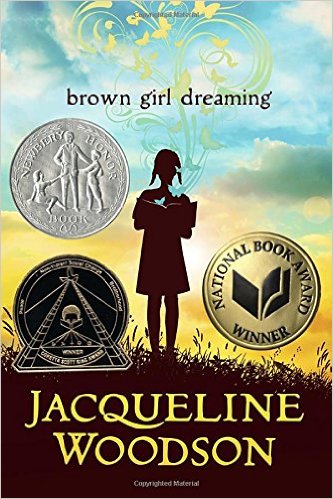 brownish daughter dreaming , 2014, Jacqueline Woodson
Find it in a Library
brownish girl dreaming is the story of the author's childhood, growing up in S Carolina and New York. Written as a series of poems, the authors shares what information technology was like for her to grow up as an African American child in the 1960s and 1970s. The poems address her growing sensation of the Civil Rights Move and finding her voice through her writing. The following is an extract:
I am built-in as the South explodes,
too many people too many years
Enslaved, so emancipated
But not costless, the people
Who look similar me
Go along fighting
And marching
And getting killed
So that today–
February 12, 1963
And every day from this moment on,
Brownish children like me can grow up
Free. Can grow up
Learning and voting and walking and riding
Wherever we desire.
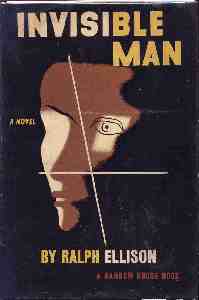 Invisible Man, 1952, Ralph Ellison
Notice information technology in a Library
A milestone book in African American literature,Invisible Man is a starting time-person business relationship of a young black human'south experiences growing up in a Southern blackness community, attending higher, and moving to New York. The unnamed man claims that he is an "invisible man," that is that others refuse to "encounter: him because he is African American.
Listen to Ralph Ellison draw his process of discovery equally he worked onInvisible Man
"(Harlem) A Dream Deferred" 1951, Langston Hughes
Read it at PoetryFoundation.org
In 1951, the twelvemonth of the poem'southward publication, the mood characterizing American blacks was frustration. Despite the passage of laws which enabled blacks to vote and to own property, there remained a continued prejudice against blacks which finer relegated them to 2d-class citizenship. They were not afforded the same opportunities in education or in employment as whites. Schools were segregated and poorly equipped without proper supplies, employment opportunities were relegated to menial jobs such equally shoe-shiners, ditch-diggers, porters, and domestic servants. Past the 1960s, the frustration had reached a boiling signal, foreshadowed by Hughes in the terminal line of his poem.
What happens to a dream deferred?
Does it dry up
like a raisin in the sun?
Or fester like a sore—
So run?
Does information technology stink like rotten meat?
Or crust and sugar over—
like a syrupy sweet?
Maybe it just sags
like a heavy load.
Or does information technology explode?
Artwork Connections
Mrs. James Smith and Grandson, 1776, Charles Willson Peale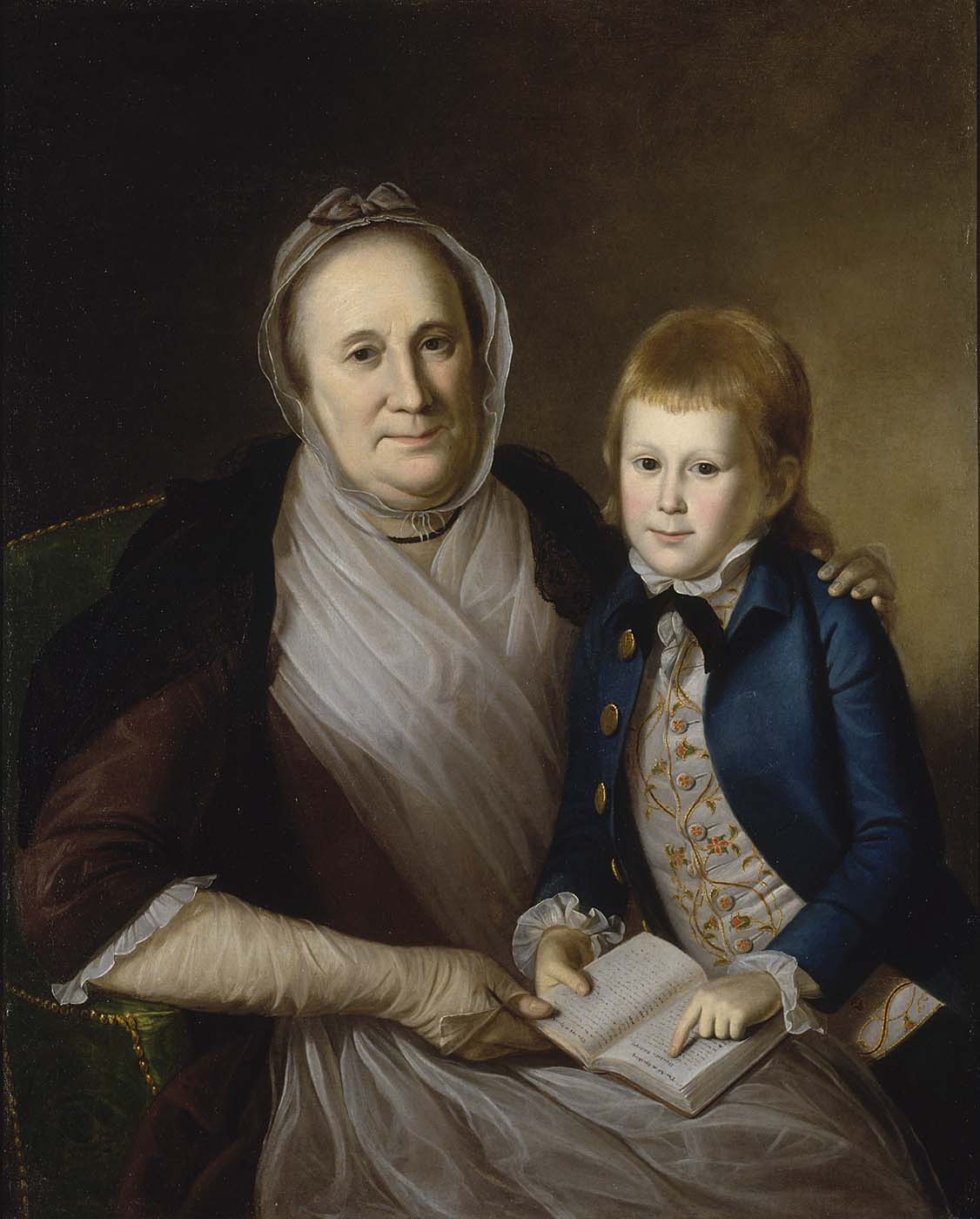
While centuries apart,UntitledandMrs. James Smith and Grandson share hitting similarities. The mature figures in both artworks express worry over the future the younger figures, either through facial expression or through particularly placed symbolic pictorial elements. Both artworks were created during a time of great modify and uncertainly; one in the years just prior to the Civil Rights Motion of the 1960s and the other at the height of the American Revolution. To acquire more than aboutMrs. James Smith and Grandson, visitWe the People…
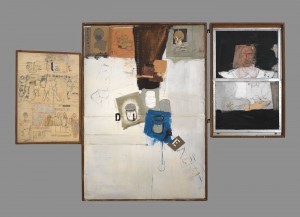
Identification Transmission , 1964, Larry Rivers
Identification Manual combines phantom images of murdered civil rights marchers with pictures of beautiful black women and products designed to bleach night skin. On the correct, two sliding panes of glass afford unlike racial identities to a figure of a woman.
A white artist (Rivers) creating racially explicit art in the 1960s was controversial, and Rivers liked to requite his works clinical, deadpan titles that fabricated the images fifty-fifty more shocking. Identification Manual conveys the difficulty faced past blacks and whites trying to find their manner through the heated conflicts of the civil rights movement. A quotation from Lord Acton, a famously liberal historian in nineteenth-century England, accompanied the title. It read: "The most certain examination by which we estimate whether a country is really free is the amount of security enjoyed by minorities."
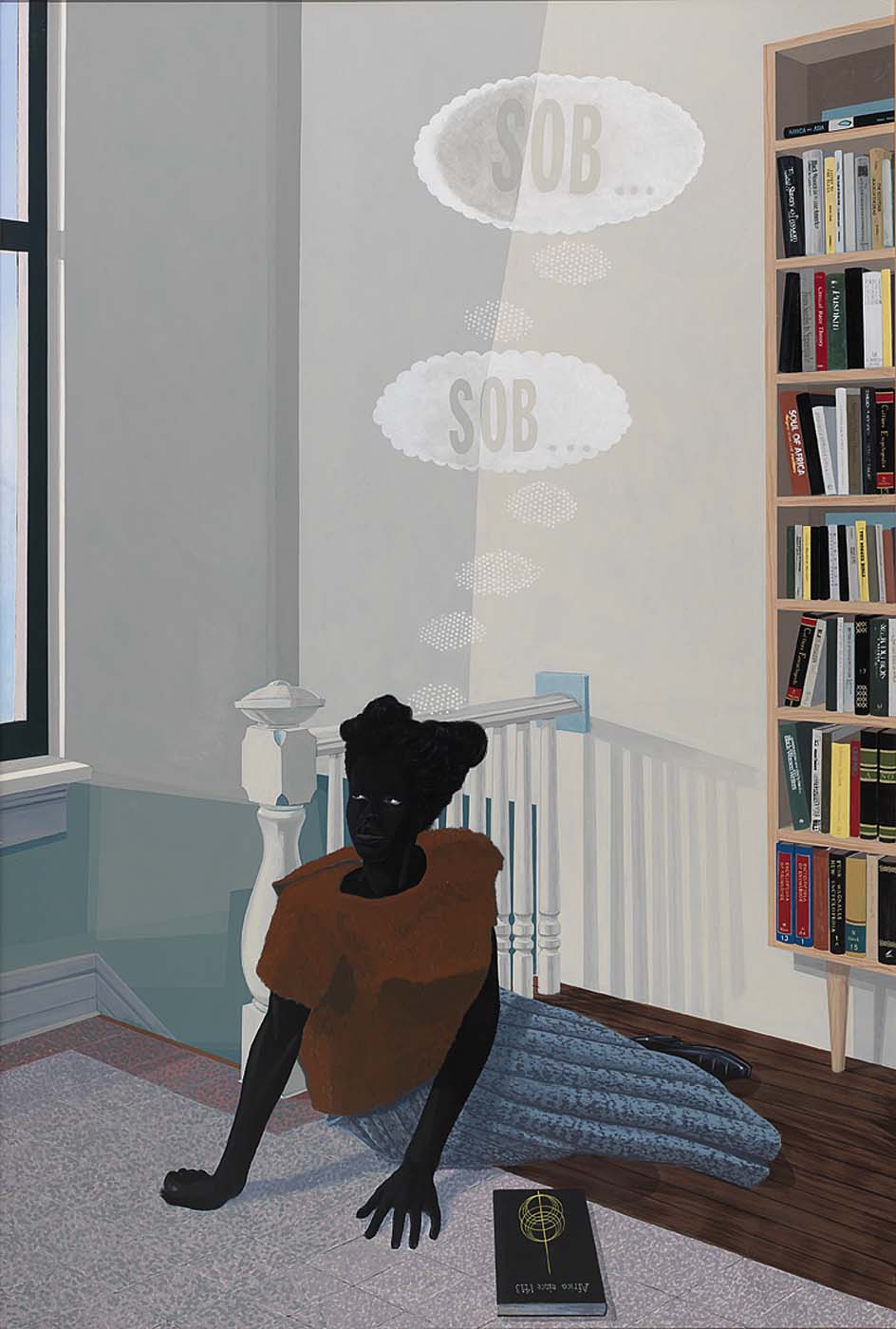
SOB, SOB, 2003, Kerry James Marshall
SOB, SOB evokes Marshall'southward intellectual journey over the concluding fifty years kickoff with his adolescence visits to the local library. According to the artist, by the third and fourth grades he knew "every unmarried fine art book in the library," and past the 7th class he was taking summer classes at the Otis Fine art Plant. SOB, SOB reflects this thirst for information. It is a painting nigh the accumulation and dissemination of cognition, and relates closely to Marshall's ongoing exploration of African American history. The painting depicts a female figure seated in front of a alpine shelf of African history books. A book titledAfrica since 1413 lies at her feet as she gazes into the sunlit interior. It'due south unclear whether her wistful gaze is one of wistful longing for a pre-colonial past or anguish over the transformation of the African continent that began in 1413 with European expeditionary missions. A thought chimera floating to a higher place the girl's head farther complicates this emotional ambivalence. The text can be read as either a cry of despair or a pointed expression of anger.
Media
Ceremonious Rights and the 1950s: Crash Class United states History – PBS (12 min) TV-M
This video teaches you near the early days of the Civil Rights movement. The 1950s were a time of economic expansion, new technologies, and a growing middle class. While the white working grade saw their wages and status amend, blacks were largely excluded from the prosperity of the 1950s. Segregation in housing and education fabricated for some serious inequality for African Americans.
Equal Protection: Crash Class Authorities and Politics – PBS (eight min) TV-Yard
This video discusses the most important part of the Constitution – the 14th Amendment. In particular, it discusses the "equal protection" clause and how it relates to our ceremonious rights; the procedure the Supreme Court follows in equal protection cases, called strict scrutiny; and the landmark case, Brown five Board of Didactics, and its office in starting the Civil Rights Movement of the 1960s.
Boosted Smithsonian Resources
Exploring all nineteen Smithsonian museums is a swell fashion to enhance your curriculum, no matter what your discipline may be. In this section, you'll observe resources that we take put together from a diversity of Smithsonian museums to enhance your students' learning feel, augment their skill set, and not only meet education standards, but exceed them.
Subject: Art
African American Art: Harlem Renaissance, Ceremonious Rights Era, and Beyond – Smithsonian American Art Museum
A option of paintings, sculpture, prints, and photographs by forty-three black artists who explored the African American experience from the Harlem Renaissance through the Civil Rights era and the decades beyond, which saw tremendous social and political changes.
Subject area: History
Certificate Deep Dive: A Play-past-Play of the March on Washington – Smithsonian Magazine
Subject: Music
Voices of Struggle: The Civil Rights Movement, 1945 to 1965 – Smithsonian Folkways
We honor African American history and music with a await at the profound cultural contribution of the Civil Rights Movement, called by Guy Carawan "the greatest singing movement this country has experienced." The African American struggle for civil rights and equality inspired the many other socio-political movements in the USA and around the world.
Lesson Plans and Pupil Activities
Divide is Not Equal: Dark-brown v. Board of Instruction – Smithsonian National Museum of American History
Document-Based Question: The March on Washington (PDF) – Smithsonian National Museum of American History
Using the provided supporting documents, the historical background, and their own prior noesis, students are asked to write a persuasive essay that takes a position debating the importance of grassroots organizing and charismatic leadership during the March on Washington.
Glossary
Grand.I. Bill: formally known as the Servicemen's Readjustment Act of 1944, the act provided a range of benefits to returning World War II veterans.
McCarran Act of 1950: this federal law, sponsored by Senator Pat McCarran (D), was enacted in response to growing domestic anti-Communist fears. It strengthened laws against espionage, limited gratuitous speech for national security reasons, and allowed for the investigation and deportation of immigrants accused of promoting Communism or engaging in subversive activities. The police is also known as the Internal Security Human activity of 1950 or the Subversive Activities Control Act of 1950.
Veteran's Administration: this is the benefits arm of the United States Department of Veterans Affairs, the government agency formed in 1930.
Standards
U.S. History Content Standards Era 9 – Mail service War United states of america (1945-early 1970s)
- Standard 1A –The educatee understands the extent and bear upon of economical changes in the postwar period.
- nine-12 – Clarify the continued gap between poverty and the rising affluence of the heart class.
- Standard 1B – The student understands how the social changes of the postwar menstruation affected various Americans.
- 5-12 – Evaluate the furnishings of the GI Nib on American society.
- ix-12 – Examine the rapid growth of secondary and collegiate instruction and the function of new governmental spending on educational programs.
- Standard 3A –The educatee understands the political debates of the postal service-World State of war Two era.
- 9-12 – Evaluate Truman's continuation of New Deal policies in labor relations, housing, education, and wellness.
- 7-12 – Assess the effectiveness of the "Great Society" programs.
- Standard 4A –The student understands the "Second Reconstruction" and its advancement of ceremonious rights.
- 7-12 – Explicate the origins of the postwar civil rights movement and the office of the NAACP in the legal assault on segregation.
- v-12 – Evaluate the Warren Court's reasoning in Brown v. Board of Instruction and its significance in advancing civil rights.
- 5-12 – Explain the resistance to civil rights in the South between 1954 and 1965.
- vii-12 – Appraise the role of the legislative and executive branches in advancing the ceremonious rights movement and the upshot of shifting the focus from de jure to de facto segregation.
gilbertsonoweig1954.blogspot.com
Source: https://americanexperience.si.edu/historical-eras/post-war-united-states/pair-untitled-library/

Post a Comment for "What Is the Displacement From the History Classroom to the Art Room?"