Centre for Art and Culture Link Between Culture and Tourism
Tourism and Civilisation
The convergence between tourism and civilization, and the increasing interest of visitors in cultural experiences, bring unique opportunities but also complex challenges for the tourism sector.
"Tourism policies and activities should be conducted with respect for the artistic, archaeological and cultural heritage, which they should protect and pass on to future generations; particular intendance should be devoted to preserving monuments, worship sites, archaeological and celebrated sites besides every bit upgrading museums which must exist widely open and accessible to tourism visits"
UNWTO Framework Convention on Tourism Ethics
Article 7, paragraph ii
This webpage provides UNWTO resources aimed at strengthening the dialogue between tourism and civilization and an informed determination-making in the sphere of cultural tourism. It also promotes the exchange of good practices showcasing inclusive direction systems and innovative cultural tourism experiences.
ABOUT CULTURAL TOURISM
Co-ordinate to the definition adopted past the UNWTO General Associates, at its 22nd session (2017), Cultural Tourism implies "A type of tourism activity in which the visitor's essential motivation is to acquire, discover, feel and consume the tangible and intangible cultural attractions/products in a tourism destination. These attractions/products relate to a set of distinctive material, intellectual, spiritual and emotional features of a social club that encompasses arts and architecture, historical and cultural heritage, culinary heritage, literature, music, creative industries and the living cultures with their lifestyles, value systems, behavior and traditions".
UNWTO provides back up to its members in strengthening cultural tourism policy frameworks, strategies and product development. It besides provides guidelines for the tourism sector in adopting policies and governance models that benefit all stakeholders, while promoting and preserving cultural elements.
Weaving the Recovery - Indigenous Women in Tourism
 At the 2022 Paris Peace Forum, UNWTO and its partners presented a Weaving the Recovery project to enable market access of indigenous women to tourism and conscious consumers through textiles, fair trade and community entrepreneurship.
This initiative, which gathers UNWTO, the World Indigenous Tourism Alliance (WINTA), Centro de las Artes Indígenas (CAI) and the NGO IMPACTO, was selected every bit one of the ten most promising projects amoung 850+ initiatives to address the nigh pressing global challenges. The project will test different methodologies in pilot communities, starting with United mexican states, to enable indigenous women admission markets and demonstrate their leadership in the post-COVID recovery.
This empowerment model, based on promoting a responsible tourism development, cultural transmission and fair-trade principles, will represent a novel customs approach with a high global replication potential.
Click here to visit the projection webpage.
INCLUSIVE RECOVERY OF CULTURAL TOURISM
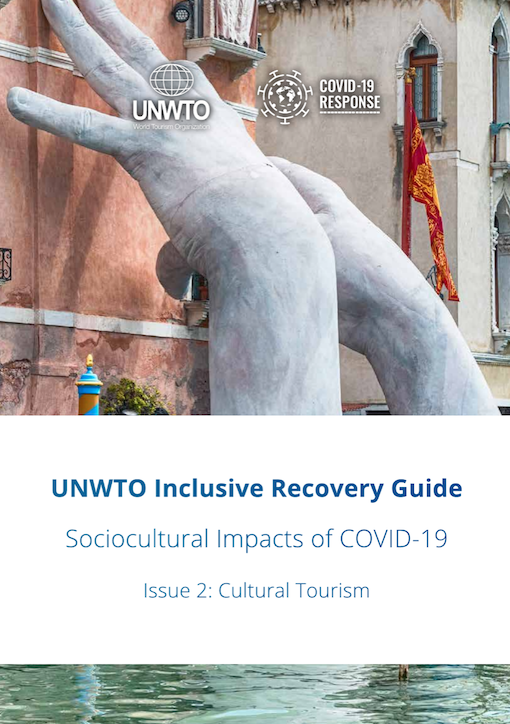 In February 2021, UNWTO launched the UNWTO Inclusive Recovery Guide - Sociocultural Impacts of COVID-19, Issue II: Cultural Tourism. UNWTO invited UNESCO to contribute to this second set of guidelines relating to the sociocultural impacts of COVID-xix. The publication draws on the insights of the two UN agencies to analyse the touch of the pandemic and suggests solutions for cultural tourism to prosper over again, nether the principles of shared responsibilities and greater inclusion.
UNWTO Inclusive Recovery Guide, Issue 4: Indigenous Communities
 UNWTO, the Globe Indigenous Tourism Alliance (WINTA) and OECD have joined efforts to contribute to the UNWTO Inclusive Recovery Guide - Sociocultural Impacts of COVID-19, Upshot 4: Indigenous Communities, the 4th fix of guidelines relating to the socio-cultural impacts of COVID-19 on tourism. This set of guidelines has been adult by the UNWTO Ethics, Culture and Social Responsibleness Section, in collaboration with Indigenous leaders, while also benefitting from inputs provided by OECD. The recommendations suggest specific solutions for the socio-economic empowerment of Indigenous Peoples through tourism. These include transitioning from "assisting" towards "enabling" indigenous entrepreneurship, strengthening skills and building capacities, fostering digital literacy for running indigenous tourism businesses, and, acknowledging the relevance of indigenous peoples and their cultural uppercase by destination government and the tourism sector, at big. (As well available in Castilian).
Sustainable Development of Indigenous Tourism
The Recommendations on Sustainable Development of Indigenous Tourism provide guidance to tourism stakeholders to develop their operations in a responsible and sustainable fashion within those indigenous communities that wish to:
- Open up to tourism evolution, or
- Improve the management of the existing tourism experiences within their communities.
They were prepared past the UNWTO Ethics, Culture and Social Responsibility Department in close consultation with indigenous tourism associations, ethnic entrepreneurs and advocates. The Recommendations were endorsed by the World Commission on Tourism Ideals and finally adopted by the UNWTO General Associates in 2019, as a landmark document of the Organization in this sphere.
Who are these Recommendations targeting?
- Tour operators and travel agencies
- Tour guides
- Indigenous communities
- Tourists
- Other stakeholders such as governments, policy makers and destinations
The Recommendations address some of the key questions regarding indigenous tourism:
 How can indigenous tourism result in equitable partnerships?
How can tourism experiences benefit both communities and tourism operators?
How can tour operators contribute to the empowerment of indigenous communities?
How tin guides promote indigenous civilisation while enriching the experience for the visitors?
How can communities be drivers of tourism entrepreneurship and protect their resource?
How tin ethnic communities prepare the limits of tourism development?
What kind of information visitors need prior to visiting indigenous communities?
How tin visitors contribute to improving the communities' livelihoods?
UNWTO/UNESCO World Conferences on Tourism and Culture
The UNWTO/UNESCO Globe Conferences on Tourism and Civilisation bring together Ministers of Tourism and Ministers of Culture with the objective to identify key opportunities and challenges for a stronger cooperation betwixt these highly interlinked fields.
Gathering tourism and civilisation stakeholders from all globe regions the conferences which take been hosted past Cambodia, Oman, Turkey and Japan have addressed a wide range of topics, including governance models, the promotion, protection and safeguarding of culture, innovation, the function of artistic industries and urban regeneration as a vehicle for sustainable development in destinations worldwide.
Fourth UNWTO/UNESCO Earth Conference on Tourism and Culture: Investing in future generations. Kyoto, Japan. 12-13 Dec 2019
Kyoto Annunciation on Tourism and Civilization: Investing in time to come generations (English, French, Spanish, Arabic, Russian and Japanese)
Third UNWTO/UNESCO World Briefing on Tourism and Culture : For the Benefit of All. Istanbul, Turkey. 3 -v Dec 2018
Istanbul Annunciation on Tourism and Civilization: For the Benefit of All
(English, French, Spanish, Arabic, Russian)
Second UNWTO/UNESCO Globe Briefing's on Tourism and Culture: Fostering Sustainable Evolution. Muscat, Sultanate of Oman. 11-12 December 2017
Muscat Proclamation on Tourism and Civilisation: Fostering Sustainable Development
(English language, French, Spanish, Arabic, Russian)
First UNWTO/UNESCO Earth Conference's on Tourism and Culture: Building a new partnership. Siem Reap, Cambodia. 4-6 February 2015
Siem Reap Announcement on Tourism and Culture – Building a New Partnership Model
UNWTO Study on Tourism and Intangible Cultural Heritage
The first UNWTO Study on Tourism and Intangible Cultural Heritage provides comprehensive baseline enquiry on the interlinkages between tourism and the expressions and skills that make upwardly humanity's intangible cultural heritage (ICH).
 The publication explores major challenges, risks and opportunities for tourism development related to ICH, while suggesting practical steps for the evolution and marketing of ICH-based tourism products.
Through a compendium of instance studies fatigued from across five continents, the report offers in-depth data on, and assay of, government-led actions, public-individual partnerships and community initiatives.
These applied examples feature tourism development projects related to six pivotal areas of ICH: handicrafts and the visual arts; gastronomy; social practices, rituals and festive events; music and the performing arts; oral traditions and expressions; and, noesis and practices concerning nature and the universe.
Highlighting innovative forms of policy-making, the UNWTO Written report on Tourism and Intangible Cultural Heritage recommends specific deportment for stakeholders to foster the sustainable and responsible evolution of tourism by incorporating and safeguarding intangible cultural assets.
UNWTO Study on Tourism and Intangible Cultural Heritage
- UNWTO Report
- Summary of the Report
gilbertsonoweig1954.blogspot.com
Source: https://www.unwto.org/tourism-and-culture

Post a Comment for "Centre for Art and Culture Link Between Culture and Tourism"