Greek Art Who Was Considered to Be a ââåbarbarianã¢ââ
The sculpture of ancient Greece from 800 to 300 BCE took inspiration from Egyptian and Virtually Eastern monumental fine art, and evolved into a uniquely Greek vision of the fine art form. Greek artists captured the man grade in a way never before seen where sculptors were particularly concerned with proportion, poise, and the idealised perfection of the man body.
Greek sculptural figures in stone and bronze have go some of the about recognisable pieces of art e'er produced by any culture and the Greek artistic vision of the human class was much copied in antiquity and has been ever since.
Influences & Evolution
From the 8th century BCE, Primitive Greece saw a rise in the production of minor solid figures in dirt, ivory, and statuary. No doubt, wood too was a commonly used medium but its susceptibility to erosion has meant few examples accept survived. Bronze figures, human heads and, in particular, griffins were used as attachments to bronze vessels such every bit cauldrons. In way, the homo figures resemble those in contemporary Geometric pottery designs, having elongated limbs and a triangular torso. Fauna figures were also produced in large numbers, especially the horse, and many have been plant across Hellenic republic at sanctuary sites such every bit Olympia and Delphi, indicating their common function every bit votive offerings.
The oldest Greek rock sculptures (of limestone) date from the mid-seventh century BCE and were found at Thera. In this menstruum, statuary free-standing figures with their own base became more common, and more ambitious subjects were attempted such as warriors, charioteers, and musicians. Marble sculpture appears from the early on 6th century BCE and the commencement monumental, life-size statues began to be produced. These had a commemorative part, either offered at sanctuaries in symbolic service to the gods or used as grave markers.
The earliest large stone figures (kouroi - nude male youths and kore - clothed female figures) were rigid every bit in Egyptian monumental statues with the arms held straight at the sides, the feet are almost together and the eyes stare blankly ahead without any particular facial expression. These rather static figures slowly evolved though and with always greater details added to hair and muscles, the figures began to come up to life.
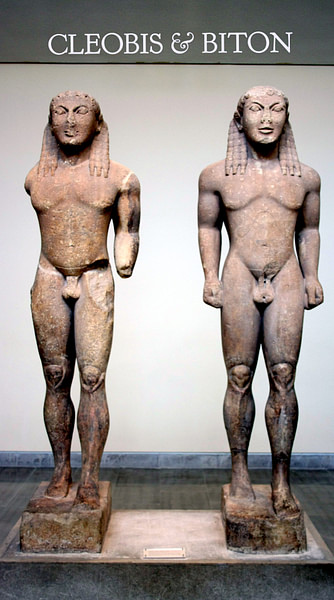
Cleobis & Biton
Slowly, arms become slightly bent giving them muscular tension and ane leg (usually the correct) is placed slightly more forward, giving a sense of dynamic movement to the statue. Excellent examples of this style of figure are the kouroi of Argos, dedicated at Delphi (c. 580 BCE). Around 480 BCE, the last kouroi become always more than life-like, the weight is carried on the left leg, the right hip is lower, the buttocks and shoulders more relaxed, the caput is non quite and then rigid, and there is a hint of a smile. Female person kore followed a similar evolution, particularly in the sculpting of their clothes which were rendered in an always-more than realistic and complex mode. A more natural proportion of the effigy was also established where the head became 1:7 with the body, irrespective of the bodily size of the statue. Past 500 BCE Greek sculptors were finally breaking away from the rigid rules of Primitive conceptual fine art and beginning to reproduce what they really observed in real life.
Sculptors strived to make the piece seem carved from the inside rather than chiselled from the exterior.
In the Classical period, Greek sculptors would break off the shackles of convention and achieve what no-1 else had ever before attempted. They created life-size and life-like sculpture which glorified the human and specially nude male form. Even more was achieved than this though. Marble turned out to exist a wonderful medium for rendering what all sculptors strive for: that is to make the slice seem carved from the inside rather than chiselled from the outside. Figures go sensuous and appear frozen in action; it seems that simply a second ago they were really alive. Faces are given more than expression and whole figures strike a particular mood. Clothes likewise become more subtle in their rendering and cling to the contours of the body in what has been described every bit 'current of air-blown' or the 'moisture-look'. Quite simply, the sculptures no longer seemed to be sculptures merely were figures instilled with life and verve.
Materials & Methods
To see how such realism was achieved we must return once again to the beginning and examine more closely the materials and tools at the disposal of the artist and the techniques employed to transform raw materials into art.
Early Greek sculpture was most often in bronze and porous limestone, just whilst bronze seems never to have gone out of mode, the rock of pick would become marble. The best was from Naxos - close-grained and sparkling, Parian (from Paros) - with a rougher grain and more translucent, and Pentelic (virtually Athens) - more than opaque and which turned a soft dearest colour with age (due to its atomic number 26 content). However, stone was chosen for its workability rather than its decoration as the majority of Greek sculpture was not polished but painted, often rather garishly for modern tastes.
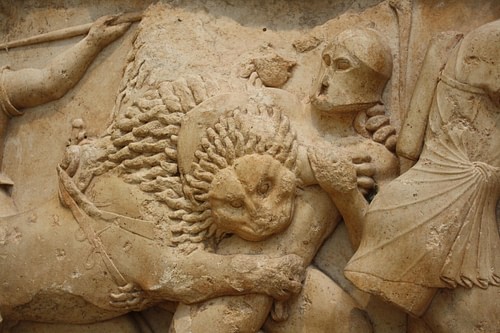
Gigantomachy, Treasury of the Siphians, Delphi
Marble was quarried using bow drills and wooden wedges soaked in water to pause away workable blocks. Mostly, larger figures were non produced from a single piece of marble, but important additions such every bit arms were sculpted separately and fixed to the chief torso with dowels. Using fe tools, the sculptor would piece of work the block from all directions (perhaps with an heart on a small-scale-scale model to guide proportions), first using a pointed tool to remove more substantial pieces of marble. Adjacent, a combination of a v-claw chisel, flat chisels of various sizes, and small manus drills were used to sculpt the fine details. The surface of the stone was then finished off with an abrasive powder (usually emery from Naxos) merely rarely polished. The statue was then attached to a plinth using a atomic number 82 fixture or sometimes placed on a single column (e.yard. the Naxian Sphinx at Delphi, c. 560 BCE). The finishing touches to statues were added using pigment. Skin, hair, eyebrows, lips, and patterns on clothing were added in brilliant colours. Eyes were ofttimes inlaid using bone, crystal, or glass. Finally, additions in statuary might be added such as spears, swords, helmets, jewellery, and diadems, and some statues fifty-fifty had a small statuary disc (meniskoi) suspended over the head to foreclose birds from defacing the effigy.
The other favoured material in Greek sculpture was bronze. Unfortunately, this material was always in demand for re-use in later periods, whereas broken marble is not much employ to anyone, and then marble sculpture has meliorate survived for posterity. Consequently, the quantity of surviving examples of bronze sculpture (no more than twelve) is not peradventure indicative of the fact that more bronze sculpture may well take been produced than in marble and the quality of the few surviving bronzes demonstrates the excellence we have lost. Very often at archaeological sites we may run across rows of bare stone plinths, silent witnesses to art'south loss.
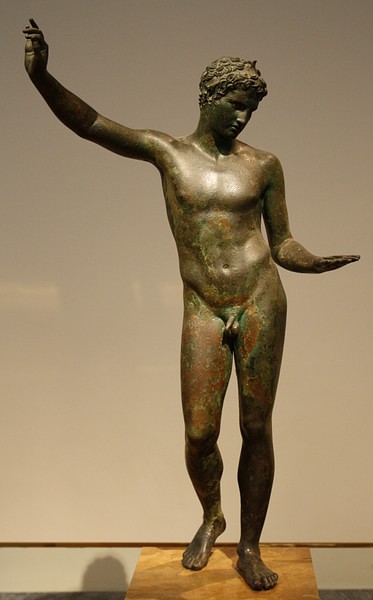
Statuary Greek Athlete
The early solid bronze sculptures fabricated fashion for larger pieces with a non-bronze core which was sometimes removed to leave a hollow figure. The most common production of bronze statues used the lost-wax technique. This involved making a cadre almost the size of the desired effigy (or torso role if not creating a whole figure) which was so coated in wax and the details sculpted. The whole was then covered in clay stock-still to the core at certain points using rods. The wax was then melted out and molten bronze poured into the space once occupied by the wax. When set up, the clay was removed and the surface finished off by scraping, fine engraving and polishing. Sometimes copper or silvery additions were used for lips, nipples and teeth. Eyes were inlaid as in marble sculpture.
Many Greek statues are signed so that we know the names of the nearly successful artists who became famous in their ain lifetimes.
Sculptors
Many statues are signed so that nosotros know the names of the nearly successful artists who became famous in their own lifetimes. Naming a few, nosotros may kickoff with the well-nigh famous of all, Phidias, the artist who created the gigantic chryselephantine statues of Athena (c. 438 BCE) and Zeus (c. 456 BCE) which resided, respectively, in the Parthenon of Athens and the Temple of Zeus at Olympia. The latter sculpture was considered one of the 7 wonders of the aboriginal earth. Polykleitos, who besides creating not bad sculpture such as the Doryphoros (Spearbearer), also wrote a treatise, the Kanon, on techniques of sculpture where he emphasised the importance of correct proportion. Other important sculptors were Kresilas, who made the much-copied portrait of Pericles (c. 425 BCE), Praxiteles, whose Aphrodite (c. 340 BCE) was the starting time full female nude, and Kallimachos, who is credited with creating the Corinthian capital and whose distinctive dancing figures were much copied in Roman times.
Sculptors often found permanent employment in the great sanctuary sites and archæology has revealed the workshop of Phidias at Olympia. Various broken clay moulds were found in the workshop and as well the principal'south ain personal clay mug, inscribed 'I belong to Phidias'. Another characteristic of sanctuary sites was the cleaners and polishers who maintained the shiny carmine-brass color of bronze figures as the Greeks did not appreciate the dark-green patina which occurs from weathering (and which surviving statues have gained).
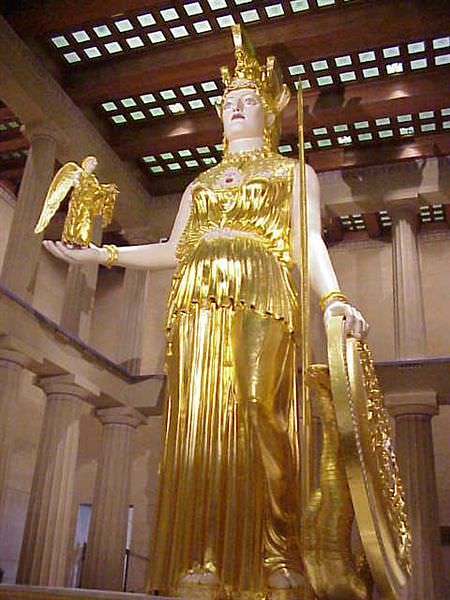
Athena Parthenos Reconstruction
The Masterpieces
Greek sculpture is, yet, not express to standing figures. Portrait busts, relief panels, grave monuments, and objects in stone such as perirrhanteria (basins supported by three or 4 standing female person figures) too tested the skills of the Greek sculptor. Some other important branch of the fine art form was architectural sculpture, prevalent from the late sixth century BCE on the pediments, friezes, and metopes of temples and treasury buildings. Notwithstanding, it is in figure sculpture that ane may find some of the slap-up masterpieces of Classical antiquity, and testimony to their course and popularity is that copies were very frequently made, particularly in the Roman flow. Indeed, it is fortunate that the Romans loved Greek sculpture and copied information technology so widely considering it is oft these copies which survive rather than the Greek originals. The copies, however, present their ain problems as they plainly lack the original chief'southward affect, may swap medium from bronze to marble, and fifty-fifty mix body parts, particularly heads.
Although words will rarely ever do justice to the visual arts, nosotros may list here a few examples of some of the most celebrated pieces of Greek sculpture. In bronze, three pieces stand out, all saved from the sea (a improve custodian of fine bronzes than people have been): the Zeus or Poseidon of Artemesium and the two warriors of Riace (all three: 460-450 BCE). The one-time could be Zeus (the posture is more common for that deity) or Poseidon and is a transitional piece between Archaic and Classical fine art every bit the effigy is extremely life-like, merely in fact, the proportions are not verbal (e.g. the limbs are extended). Yet, as Boardman eloquently describes, "(it) manages to be both vigorously threatening and static in its perfect residual"; the onlooker is left in no uncertainty at all that this is a great god. The Riace warriors are also magnificent with the added detail of finely sculpted hair and beards. More Classical in manner, they are perfectly proportioned and their poise is rendered in such a mode every bit to suggest that they may well step off of the plinth at any moment.
In marble, two standout pieces are the Diskobolos or discus thrower attributed to Myron (c. 450 BCE) and the Nike of Paionios at Olympia (c. 420 BCE). The discus thrower is one of the most copied statues from antiquity and it suggests powerful muscular motion caught for a carve up 2d, as in a photo. The piece is also interesting because it is carved in such a fashion (in a single plain) as to be seen from ane viewpoint (like a relief etching with its background removed). The Nike is an fantabulous case of the 'moisture-look' where the lite cloth of the clothing is pressed against the contours of the trunk, and the effigy seems semi-suspended in the air and only just to have landed her toes on the plinth.
Decision
Greek sculpture and then, broke free from the creative conventions which had held sway for centuries across many civilizations, and instead of reproducing figures according to a prescribed formula, they were free to pursue the idealised form of the man body. Hard, lifeless fabric was somehow magically transformed into such intangible qualities as poise, mood, and grace to create some of the great masterpieces of earth art and inspire and influence the artists who were to follow in Hellenistic and Roman times who would become on to produce more masterpieces such as the Venus de Milo. Further, the perfection in proportions of the human body accomplished by Greek sculptors continues to inspire artists fifty-fifty today. The great Greek works are even consulted by 3D artists to create accurate virtual images and by sporting governing bodies who accept compared athletes bodies with Greek sculpture to cheque abnormal muscle evolution achieved through the use of banned substances such as steroids.
This article has been reviewed for accuracy, reliability and adherence to academic standards prior to publication.
gilbertsonoweig1954.blogspot.com
Source: https://www.worldhistory.org/Greek_Sculpture/

Post a Comment for "Greek Art Who Was Considered to Be a ââåbarbarianã¢ââ"