Websites That Help Inform Families on Early Childhood Development

A test written past a four-twelvemonth-old child in 1972, in the sometime Soviet Spousal relationship. The lines are not ideal, merely the teacher (all red writing) gave the all-time grade (5) anyway.

Geography in Montessori Early Childhood at QAIS
Early childhood education (ECE), also known every bit nursery education, is a branch of teaching theory that relates to the teaching of children (formally and informally) from birth up to the age of eight.[1] Traditionally, this is upward to the equivalent of third class.[ii] ECE is described as an important period in child development.
ECE emerged as a field of study during the Enlightenment, particularly in European countries with high literacy rates.[3] It continued to grow through the nineteenth century as universal main education became a norm in the Western earth. In contempo years, early on childhood education[iv] has get a prevalent public policy outcome, as funding for preschool and pre-1000 is debated by municipal, country, and federal lawmakers.[5] [6] [7] Governing entities are besides debating the central focus of early on childhood education with debate on developmental appropriate play versus strong academic grooming curriculum in reading, writing, and math.[8] The global priority placed on early childhood education is underscored with targets of the United Nations Sustainable Evolution Goal 4.
ECE is also a professional person designation earned through a postal service-secondary education program. For example, in Ontario, Canada, the designations ECE (Early Childhood Educator) and RECE (Registered Early Childhood Educator) may merely be used past registered members of the College of Early on Childhood Educators, which is fabricated upwards of accredited child intendance professionals who are held accountable to the College's standards of practice.[9]
Theories of kid development [edit]
The Developmental Interaction Approach is based on the theories of Jean Piaget, Erik Erikson, John Dewey, and Lucy Sprague Mitchell. The approach focuses on learning through discovery.[x] Jean Jacques Rousseau recommended that teachers should exploit private children's interests to brand sure each child obtains the data most essential to his personal and individual evolution.[11] The v developmental domains of childhood development include:[12] To meet those developmental domains, a child has a set of needs that must be met for learning. Maslow's hierarchy of needs showcases the different levels of needs that must exist met the chart to the right showcases these needs.[thirteen]

Maslow's Hierarchy of Needs
- Physical: the way in which a kid develops biological and physical functions, including eyesight and motor skills
- Social: the mode in which a child interacts with others[14] Children develop an understanding of their responsibilities and rights as members of families and communities, as well as an power to relate to and work with others.[xv]
- Emotional: the way in which a child creates emotional connections and develops self-confidence. Emotional connections develop when children relate to other people and share feelings.
- Language: the mode in which a kid communicates, including how they present their feelings and emotions, both to other people and to themselves. At 3 months, children employ different cries for different needs. At six months they can recognize and imitate the basic sounds of spoken language. In the first 3 years, children demand to exist exposed to communication with others in order to pick up language. "Normal" linguistic communication development is measured by the rate of vocabulary acquisition.[sixteen]
- Cognitive skills: the fashion in which a child organizes information. Cognitive skills include problem solving, creativity, imagination and retentiveness.[17] They embody the way in which children make sense of the globe. Piaget believed that children exhibit prominent differences in their thought patterns as they move through the stages of cognitive evolution: sensorimotor menstruation, the pre-operational period, and the operational period.[18]
Vygotsky's socio-cultural learning theory [edit]
Russian psychologist Lev Vygotsky proposed a "socio-cultural learning theory" that emphasized the touch on of social and cultural experiences on private thinking and the evolution of mental processes.[xix] Vygotsky's theory emerged in the 1930s and is nonetheless discussed today as a means of improving and reforming educational practices. In Vygotsky'due south theories of learning, he also postulated the theory of the zone of proximal evolution. This theory ties in with children building off prior knowledge and gaining new noesis related to skills they already take. In the theory it describes how new knowledge or skills are taken in if they are not fully learned but are starting to sally. A teacher or older friend lends back up to a child learning a skill, be it building a block castle, tying a shoe, or writing 1'southward name. Every bit the child becomes more capable of the steps of the activity, the adult or older kid withdraws supports gradually, until the child is competent completing the process on his/her ain. This is done within that activity's zone—the distance between where the child is, and where he potentially will be.[20] In each zone of proximal evolution, they build on skills and grow by learning more than skills in their proximal development range. They build on the skills by being guided by teachers and parents. They must build from where they are in their zone of proximal evolution.[21]
Vygotsky argued that since cognition occurs within a social context, our social experiences shape our ways of thinking about and interpreting the world.[22] People such as parents, grandparents, and teachers play the roles of what Vygotsky described as knowledgeable and competent adults. Although Vygotsky predated social constructivists, he is normally classified every bit one. Social constructivists believe that an individual's cognitive arrangement is a resditional learning time. Vygotsky advocated that teachers facilitate rather than direct educatee learning.[23] Teachers should provide a learning surround where students tin explore and develop their learning without direct educational activity. His approach calls for teachers to incorporate students' needs and interests. It is important to do this because students' levels of interest and abilities will vary and there needs to be differentiation.
However, teachers can heighten understandings and learning for students. Vygotsky states that by sharing meanings that are relevant to the children'due south surround, adults promote cognitive evolution equally well. Their teachings can influence thought processes and perspectives of students when they are in new and similar environments. Since Vygotsky promotes more facilitation in children's learning, he suggests that knowledgeable people (and adults in particular), can too enhance knowledges through cooperative meaning-making with students in their learning.[24] Vygotsky's approach encourages guided participation and student exploration with support. Teachers can help students achieve their cognitive development levels through consequent and regular interactions of collaborative noesis-making learning processes.
Piaget's constructivist theory [edit]
Jean Piaget's constructivist theory gained influence in the 1970s and '80s. Although Piaget himself was primarily interested in a descriptive psychology of cognitive development, he also laid the groundwork for a constructivist theory of learning.[25] Piaget believed that learning comes from within: children construct their own knowledge of the world through experience and subsequent reflection. He said that "if logic itself is created rather than existence inborn, it follows that the kickoff task of education is to grade reasoning." Within Piaget's framework, teachers should guide children in acquiring their own knowledge rather than only transferring knowledge.[26]
According to Piaget's theory, when young children encounter new data, they attempt to accommodate and assimilate information technology into their existing understanding of the world. Adaptation involves adapting mental schemas and representations to make them consistent with reality. Assimilation involves fitting new information into their pre-existing schemas. Through these two processes, young children acquire by equilibrating their mental representations with reality. They too acquire from mistakes.[27]
A Piagetian approach emphasizes experiential education; in schoolhouse, experiences become more easily-on and physical as students explore through trial and error.[28] Thus, crucial components of early childhood education include exploration, manipulating objects, and experiencing new environments. Subsequent reflection on these experiences is equally important.[29]
Piaget's concept of reflective abstraction was particularly influential in mathematical educational activity.[thirty] Through cogitating abstraction, children construct more advanced cerebral structures out of the simpler ones they already possess. This allows children to develop mathematical constructs that cannot be learned through equilibration – making sense of experiences through assimilation and adaptation – alone.[31]
According to Piagetian theory, language and symbolic representation is preceded past the development of corresponding mental representations. Inquiry shows that the level of reflective abstraction achieved by young children was found to limit the degree to which they could represent physical quantities with written numerals. Piaget held that children can invent their own procedures for the four arithmetical operations, without being taught any conventional rules.[32]
Piaget's theory implies that computers tin can be a bang-up educational tool for young children when used to support the blueprint and construction of their projects. McCarrick and Xiaoming establish that computer play is consistent with this theory.[33] However, Plowman and Stephen institute that the effectiveness of computers is express in the preschool surround; their results signal that computers are simply constructive when directed past the teacher.[34] This suggests, according to the constructivist theory, that the role of preschool teachers is critical in successfully adopting computers as they existed in 2003.[35]
Kolb'southward experiential learning theory [edit]
David Kolb's experiential learning theory, which was influenced past John Dewey, Kurt Lewin and Jean Piaget, argues that children need to experience things to learn: "The procedure whereby cognition is created through the transformation of experience. Knowledge results from the combinations of grasping and transforming experience." The experimental learning theory is distinctive in that children are seen and taught equally individuals. As a child explores and observes, teachers inquire the child probing questions. The child can so adapt prior cognition to learning new information.
Kolb breaks down this learning bike into four stages: physical feel, cogitating observation, abstract conceptualization, and active experimentation. Children observe new situations, think most the situation, brand meaning of the state of affairs, then exam that meaning in the earth effectually them.[36]
Practical implications of early childhood instruction [edit]
In recent decades, studies have shown that early childhood didactics is critical in preparing children to enter and succeed in the (class school) classroom, diminishing their risk of social-emotional mental health problems and increasing their self-sufficiency afterwards in their lives.[37] In other words, the child needs to be taught to rationalize everything and to be open to interpretations and critical thinking. There is no subject to be considered taboo, starting with the well-nigh basic knowledge of the world that they live in, and ending with deeper areas, such equally morality, religion and science. Visual stimulus and response time as early equally three months can be an indicator of verbal and operation IQ at age 4 years.[38] When parents value ECE and its importance their children mostly take a higher rate of attendance. This allows children the opportunity to build and nurture trusting relationships with educators and social relationships with peers.[ citation needed ]
By providing pedagogy in a child'due south most formative years, ECE also has the capacity to pre-emptively begin closing the educational achievement gap between depression and high-income students earlier formal schooling begins.[39] Children of low socioeconomic status (SES) often begin school already behind their higher SES peers; on average, by the fourth dimension they are three, children with loftier SES take three times the number of words in their vocabularies as children with low SES.[xl] Participation in ECE, however, has been proven to increment loftier school graduation rates, improve performance on standardized tests, and reduce both grade repetition and the number of children placed in special educational activity.[41]
A study was conducted by the Aga Khan Evolution Network's Madrasa Early Childhood Programme on the bear on that early childhood education had on students' functioning in course school. Looking specifically at students who attended the Madrasa Early Childhood schools (near all of whom came from economically disadvantaged backgrounds), the study found that they had consistently ranked in the summit twenty% in grade 1 classes. The study besides concluded that any formal early on childhood education contributed to college levels of cerebral development in language, mathematics, and not-exact reasoning skills.[42]
Especially since the start wave of results from the Perry Preschool Project were published, there has been widespread consensus that the quality of early on childhood pedagogy programs correlate with gains in low-income children'south IQs and test scores, decreased grade retentivity, and lower special education rates.[ citation needed ]
Several studies have reported that children enrolled in ECE increase their IQ scores past 4–11 points by age five, while a Milwaukee study reported a 25-point proceeds.[43] In improver, students who had been enrolled in the Abecedarian Project, an oft-cited ECE written report, scored significantly college on reading and math tests by age xv than comparable students who had not participated in early childhood programs.[44] In addition, 36% of students in the Abecedarian Preschool Study treatment group would later enroll in 4-year colleges compared to 14% of those in the command group.[44]
In 2017, researchers reported that children who participate in ECE graduate high school at significantly greater rates than those who do non. Additionally, those who participate in ECE require special education and must echo a form at significantly lower rates than their peers who did not receive ECE.[45] The NIH asserts that ECE leads to higher test scores for students from preschool through age 21, improved grades in math and reading, and stronger odds that students volition keep going to school and attend college.[46]
Nathaniel Hendren and Ben Sprung-Keyser, two Harvard economists, found high Marginal Values of Public Funds (MVPFs) for investments in programs supporting the health and early education of children, particularly those that achieve children from depression-income families. The average MVPF for these types of initiatives is over 5, while the MVPFs for programs for adults more often than not range from 0.v to two.[47]
Beyond benefitting societal good, ECE too significantly impacts the socioeconomic outcomes of individuals. For example, by age 26, students who had been enrolled in Chicago Kid-Parent Centers were less likely to exist arrested, abuse drugs, and receive food stamps; they were more than likely to have high schoolhouse diplomas, health insurance and total-fourth dimension employment.[48] Studies also show that ECE heightens social engagement, bolsters lifelong health, reduces the incidence of teen pregnancy, supports mental wellness, decreases the risk of eye disease, and lengthens lifespans.[49]
The World Banking concern's 2019 World Evolution Report on The Changing Nature of Work [50] identifies early babyhood evolution programs every bit ane of the most effective means governments can equip children with the skills they volition need to succeed in time to come labor markets.
According to a 2020 written report in the Journal of Political Economy by Clemson University economist Jorge Luis García, Nobel laureate James J. Heckman and Academy of Southern California economists Duncan Ermini Foliage and María José Prados, every dollar spent on a high-quality early-childhood programs led to a return of $7.3 over the long-term.[51]
The Perry Preschool Project [edit]
The Perry Preschool Project, which was conducted in the 1960s in Ypsilanti, Michigan, is the oldest social experiment in the field of early childhood educational activity and has heavily influenced policy in the United States and across the globe.[52] The experiment enrolled 128 three- and iv-yr-old African-American children with cognitive disadvantage from low-income families, who were so randomly assigned to treatment and control groups. The intervention for children in the treatment grouping included active learning preschool sessions on weekdays for 2.v hours per day. The intervention also included weekly visits by the teachers to the homes of the children for about one.5 hours per visit to ameliorate parent-kid interactions at home.[53]
Initial evaluations of the Perry intervention showed that the preschool program failed to significantly boost an IQ measure. However, later evaluations that followed upwardly the participants for more fifty years have demonstrated the long-term economic benefits of the plan, fifty-fifty subsequently bookkeeping for the small sample size of the experiment, flaws in its randomization process, and sample attrition.[54] [55] There is substantial evidence of large treatment furnishings on the criminal convictions of male person participants, especially for violent crime, and their earnings in center adulthood. Research points to improvements in non-cerebral skills, executive functioning, childhood home environment, and parental attachment as potential sources of the observed long-term impacts of the program. The intervention's many benefits as well include improvements in belatedly-midlife health for both male and female participants.[55] Perry promoted educational attainment through ii avenues: full years of education attained and rates of progression to a given level of instruction. This blueprint is peculiarly axiomatic for females. Treated females received less special education, progressed more quickly through grades, earned higher GPAs, and attained higher levels of education than their control group counterparts.[56]
Research likewise demonstrates spillover furnishings of the Perry program on the children and siblings of the original participants. A study concludes, "The children of treated participants take fewer schoolhouse suspensions, higher levels of didactics and employment, and lower levels of participation in crime, compared with the children of untreated participants. Impacts are especially pronounced for the children of male participants. These treatment furnishings are associated with improved childhood dwelling house environments."[57] The study as well documents beneficial impacts on the male siblings of the original participants. Evidence from the Perry Preschool Projection is noteworthy because it advocates for public spending on early childhood programs as an economic investment in a society's future, rather than in the interest of social justice.[58]
International agreements [edit]
The showtime Earth Briefing on Early Childhood Care and Instruction took place in Moscow from 27 to 29 September 2010, jointly organized by UNESCO and the city of Moscow. The overarching goals of the conference are to:
- Reaffirm ECCE as a right of all children and as the ground for development
- Take stock of the progress of Member States towards achieving the EFA Goal 1
- Identify bounden constraints toward making the intended equitable expansion of access to quality ECCE services
- Establish, more concretely, benchmarks and targets for the EFA Goal 1 toward 2015 and beyond
- Identify key enablers that should facilitate Member States to reach the established targets
- Promote global commutation of good practices[59]
According to UNESCO, a preschool curriculum is one that delivers educational content through daily activities and furthers a child's physical, cerebral, and social development. Mostly, preschool curricula are just recognized past governments if they are based on academic research and reviewed by peers.[60]
Preschool for Child Rights have pioneered into preschool curricular areas and is contributing into child rights through their preschool curriculum.[61]
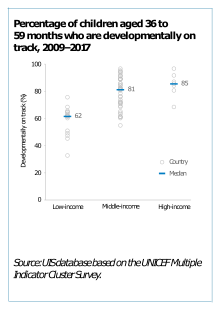
Percentage of children aged 36 to 59 months who are developmentally on track, 2009–2017
Curricula in early childhood intendance and educational activity [edit]
Curricula in early childhood care and education (ECCE) is the driving strength behind any ECCE programme. It is 'an integral role of the engine that, together with the energy and motivation of staff, provides the momentum that makes programmes live'.[62] Information technology follows therefore that the quality of a programme is profoundly influenced by the quality of its curriculum. In early childhood, these may be programs for children or parents, including health and nutrition interventions and prenatal programs, as well as center-based programs for children.[63]
Barriers and challenges [edit]
Children'south learning potential and outcomes are negatively affected by exposure to violence, corruption and child labour. Thus, protecting young children from violence and exploitation is part of broad educational concerns. Due to difficulties and sensitivities around the effect of measuring and monitoring child protection violations and gaps in defining, collecting and analysing advisable indicators,[64] data coverage in this area is scant. Yet, proxy indicators tin be used to assess the situation. For example, ratification of relevant international conventions indicates countries' commitment to kid protection. By April 2014, 194 countries had ratified the CRC3; and 179 had ratified the 1999 International Labour Organization'south Convention (No. 182) apropos the emptying of the worst forms of child labour. Still, many of these ratifications are yet to be given total event through actual implementation of concrete measures. Globally, 150 million children anile 5–14 are estimated to be engaged in kid labour.[64] In conflict-affected poor countries, children are twice as likely to die before their fifth birthday compared to those in other poor countries.[65] In industrialized countries, 4 per cent of children are physically abused each year and 10 per cent are neglected or psychologically driveling.[64] [66]
In both developed and developing countries, children of the poor and the disadvantaged remain the to the lowest degree served. This exclusion persists against the testify that the added value of early childhood care and instruction services are higher for them than for their more than affluent counterparts, even when such services are of small-scale quality. While the trouble is more intractable in developing countries, the adult world still does not equitably provide quality early childhood intendance and education services for all its children. In many European countries, children, mostly from low-income and immigrant families, do non have access to good quality early childhood care and education.[67] [66]
Orphan teaching [edit]
A lack of education during the early childhood years for orphans is a worldwide concern. Orphans are at higher risk of "missing out on schooling, living in households with less food security, and suffering from anxiety and depression."[68] Education during these years has the potential to improve a child's "food and nutrition, health care, social welfare, and protection."[68] This crisis is especially prevalent in Sub-Saharan Africa which has been heavily impacted past the aids epidemic. UNICEF reports that "13.3 million children (0–17 years) worldwide have lost one or both parents to AIDS. Nearly 12 million of these children live in sub-Saharan Africa."[68] Government policies such as the Free Basic Education Policy accept worked to provide pedagogy for orphan children in this area, but the quality and inclusiveness of this policy has brought criticism.[69]
Notable early babyhood educators [edit]
- Fred Rogers
- Charles Eugene Beatty
- Friedrich Fröbel
- Elizabeth Harrison
- David P. Weikart
- Juan Sánchez Muliterno, President of The Globe Association of Early Childhood Educators
- Maria Montessori
Come across also [edit]
- Baby video
- Bright from the Start
- Compensatory teaching
- Head Start Program
- Pretend play
- Men in early childhood education
- Montessori instruction
- Playwork
- Preschool Curriculum
- Primary instruction
- Reading
- Reggio Emilia approach
- Waldorf education
References [edit]
Citations [edit]
- ^ "National Association for the Education of Immature Children". Nigh The states. Archived from the original on 6 April 2019. Retrieved 12 July 2018.
- ^ "Best Accredited Online Early Babyhood Educational activity Degrees of 2018". Teacher Certification Degrees. Archived from the original on 8 January 2019. Retrieved 29 Oct 2018.
- ^ Eddy, Matthew Daniel (2016). "The Kid Writer: Graphic Literacy and the Scottish Educational System, 1700–1820" (PDF). History of Pedagogy. 46 (6): 695–718. doi:10.1080/0046760X.2016.1197971. S2CID 151785513. Archived (PDF) from the original on 23 July 2018. Retrieved 27 May 2020.
- ^ "Early childhood education - Asha Maa Foundation". 19 July 2021. Archived from the original on 19 July 2021. Retrieved 19 July 2021.
- ^ "Early Learning from Nascence through Tertiary Grade". National Governor'southward Association. Archived from the original on 20 Dec 2014. Retrieved 16 December 2014.
- ^ "Why Cities Are Making Preschool Education Available to All Children". Archived from the original on vii February 2015. Retrieved half dozen February 2015.
- ^ "Pre-K Funding from State and Federal Sources". 25 April 2014. Archived from the original on 11 March 2015. Retrieved 6 Feb 2015.
- ^ Ofsted (30 Nov 2017). "Bold Beginnings" (PDF). gov.uk. Archived (PDF) from the original on 28 July 2021. Retrieved 15 July 2021.
- ^ "College of Early Childhood Educators". Higher of Early Childhood Educators. Archived from the original on 8 May 2019. Retrieved 5 November 2017.
- ^ Shapiro, E.; Nager, Due north. (1999). "The Developmental-Interaction Arroyo to Education: Retrospect and Prospect". Occasional Newspaper Series. 1999 (ane). Bank Street College of Education. Archived from the original on 14 February 2020. Retrieved xiv November 2018.
"Depository financial institution Street Developmental Interaction Approach". State of New Jersey Department of Education. Archived from the original on 18 November 2011.
Casper, V; Theilheimer, R (2009). Introduction to early on childhood education: Learning together. New York: McGraw-Hill. - ^ McDowall Clark, R (2013). Babyhood in Society . London: Learning Matters.
- ^ Jonathan Doherty; Malcolm Hughes (2009). Child Evolution: Theory and Practise 0–eleven. Addison-Wesley, Incorporated. ISBN978-1-4058-2127-8.
- ^ Jones, Denisha (8 March 2019). "APPLYING MASLOW TO SCHOOLS: A NEW APPROACH TO SCHOOL EQUITY". Defending the Early Years. Archived from the original on 26 Feb 2019. Retrieved 25 February 2019.
- ^ Jeffrey Trawick-Smith (2014). Early Childhood Development: A Multicultural Perspective. Pearson Didactics, Limited. p. three. ISBN978-0-13-335277-one.
- ^ "[ARCHIVED CONTENT] Spiritual, moral, social and cultural evolution – Schools". nationalarchives.gov.britain. Archived from the original on 3 September 2013.
- ^ NIH (2011) Speech and language evolution milestones Archived 28 January 2016 at the Wayback Machine, USA: NIDCD: (accessed 15 Apr 2014).
- ^ Sally Neaum (17 May 2013). Child Development for Early Years Students and Practitioners. SAGE Publications. ISBN978-one-4462-6753-0.
- ^ Doherty, J. and Hughes, M. (2009). Child development: theory and practice 0–eleven. Harlow: Longman.
- ^ Vygotsky, Lev S. (1978). Cole, Michael; John-Steiner, Vera; Scribner, Sylvia; Souberman, Ellen (eds.). Mind in Gild: the Development of Higher Psychological Processes .
- ^ "Zone of Proximal Development – an overview | ScienceDirect Topics". sciencedirect.com. Archived from the original on 24 Feb 2020. Retrieved 24 February 2020.
- ^ Mohammad, Khatib (December 2010). "Vygotsky's Zone of Proximal Development: Instructional Implications and Teachers' Professional Evolution" (PDF). English language Language Educational activity: 12. Archived (PDF) from the original on 11 April 2019. Retrieved 25 February 2019.
- ^ Jaramillo 1996.
- ^ Jaramillo, J (1996). "Vygotsky's Sociocultural Theory and Contributions to the Development of Constructivist Curricula". Pedagogy. 117 (1): 133–140.
- ^ McDevitt, T.Grand. & Ormrod, J.E. (2016). Cognitive Evolution: Piaget and Vygotsky. In Kid Evolution and Education. (pp. 196–235). Pearson.
- ^ Smith, L (1985). "Making Educational Sense of Piaget's Psychology". Oxford Review of Instruction. 11 (2): 181–191. doi:10.1080/0305498850110205.
- ^ "Jean Piaget: Champion of children's ideas". Scholastic Early Childhood Today. 15 (five): 43. 2001.
- ^ Piaget, J (1997). "Evolution and Learning". Readings on the Development of Children: 7–20.
- ^ "Jean Piaget: Champion of Children's Ideas". Scholastic Early Babyhood Today. 15 (five): 43. 2001.
- ^ "Constructivism every bit a Paradigm for Teaching and Learning". Thirteen | Ed Online. Educational Dissemination Corporation. 2004. Archived from the original on five November 2019. Retrieved ix Feb 2015.
- ^ Kato; Kamii, Ozaki, Nagahiro (2002). "Young Children'southward Representations of Groups of Objects: The Human relationship Betwixt Abstraction and Representation". Journal for Inquiry and Mathematics Education. 33 (one): xxx–45. doi:ten.2307/749868. JSTOR 749868.
{{cite journal}}: CS1 maint: multiple names: authors list (link) - ^ Simon; Tzur, Heinz, Kinzel (2004). "Explicating a mechanism for conceptual learning' elaborating the construct of reflective abstraction". Journal for Research and Mathematics Education. 35 (5): 305–329. doi:ten.2307/30034818. JSTOR 30034818.
{{cite periodical}}: CS1 maint: multiple names: authors listing (link) - ^ Kamii; Ewing (1996). "Basing teaching on Piaget'southward constructivism". Childhood Education. 72 (5): 260. doi:10.1080/00094056.1996.10521862.
- ^ McCarrick; Xiaoming (2007). "Buried treasure: the touch of computer utilize on young children's social, cognitive, language development and motivation". AACE Journal. 15 (1): 73–95.
- ^ Plowman; Stephen (2003). "A 'first add-on'? Inquiry on ICT and preschool children". Periodical of Reckoner Assisted Learning. 19 (2): 149–164. doi:10.1046/j.0266-4909.2003.00016.x. hdl:1893/459.
- ^ Towns (2010). "Calculator didactics and estimator apply by preschool educators". ProQuest 365702854.
- ^ "David Kolb". Archived from the original on 10 February 2015. Retrieved half-dozen February 2015.
- ^ Connecticut Office of Early Childhood Planning, 2013
- ^ Dougherty and Haith of the University of Denver, "Infant Expectations and Reaction Time as Predictors of Childhood Speed of Processing and IQ", published in volume 33 (1997) of the journal Developmental Psychology.
- ^ Coleman, J. S., Campbell, E. Q., Hobson, C. J., McPartland, J., Mood, A. One thousand., Weinfeld, F. D., & York, R. L. (1966). Equality of educational opportunity: Summary written report (Vol. two). Us Section of Health, Education, and Welfare, Office of Educational activity.
- ^ Hart, B., & Risley, T. R. (1995). Meaningful differences in the everyday experience of young American children. If a parent values the benefits of ECE, then they are more likely to take college attendance, which aids children in forming meaningful relationships with their educators and peers. Paul H Brookes Publishing.
- ^ Schweinhart, 50.J., Montie, J., Xiang, Z., Barnett, Due west.S., Belfield, C.R., and Nores, M. (2005). Lifetime furnishings: The High/Scope Perry Preschool study through age 40. Ypsilanti: High/Scope Press, 2005.
- ^ Bartlett, Kathy, Judy Evans, and Shafique North. Virani. The Madrasa Early Childhood Programme: 25 Years of Experience. Geneva: Aga Khan Foundation and Rockhopper Television receiver, 2008 https://www.academia.edu/37253564/The_Madrasa_Early_Childhood_Programme_25_Years_of_Experience Archived 14 August 2021 at the Wayback Motorcar
- ^ Barnett, Westward. South. (1995). Long-term effects of early childhood programs on cognitive and school outcomes. The future of children, 25–l.
- ^ a b Campbell, F. A., Ramey, C. T., Pungello, East., Sparling, J., & Miller-Johnson, Due south. (2002). Early childhood education: Young adult outcomes from the Abecedarian Project. Applied Developmental Science, vi(1), 42–57.
- ^ McCoy, Dana Charles; Yoshikawa, Hirokazu; Ziol-Guest, Kathleen K.; Duncan, Greg J.; Schindler, Holly Due south.; Magnuson, Katherine; Yang, Rui; Koepp, Andrew; Shonkoff, Jack P. (2017). "Impacts of Early on Childhood Education on Medium- and Long-term Educational Outcomes". Educational Researcher. 46 (8): 474–497. doi:10.3102/0013189X17737739. PMC6107077. PMID 30147124.
- ^ "Why Is Early Learning Important?". National Institutes of Health: Eunice Kennedy Shriver National Found of Child Wellness and Human Development. National Institutes of Wellness. Archived from the original on 18 December 2019. Retrieved 18 December 2019.
- ^ Hendren, Nathaniel; Sprung-Keyser, Ben (2019). "A Unified Welfare Analysis of Government Policies" (PDF). Working Newspaper. Archived (PDF) from the original on xviii December 2019. Retrieved xviii December 2019.
- ^ Heckman, 2013
- ^ Sneha Elango; Jorge Luis García; James J. Heckman; Andrés Hojman (2016). "Early Babyhood Didactics" (PDF). In Moffitt, Robert A. (ed.). Economics of Ways-Tested Programs in the United States (Volume ii ed.). Chicago: University of Chicago Press. pp. 235–297. Archived (PDF) from the original on 18 Dec 2019. Retrieved 18 December 2019. and "Why Is Early Learning Important?". National Institutes of Health: Eunice Kennedy Shriver National Establish of Child Wellness and Human Development. National Institutes of Health. Archived from the original on xviii December 2019. Retrieved 18 December 2019.
- ^ "World Depository financial institution World Evolution Report 2019: The Changing Nature of Work" (PDF). Archived (PDF) from the original on 6 September 2019. Retrieved 11 October 2018.
- ^ García, Jorge Luis; Heckman, James J.; Leaf, Duncan Ermini; Prados, María José (2 Baronial 2019). "Quantifying the Life-Cycle Benefits of an Influential Early-Childhood Plan". Periodical of Political Economy. 128 (7): 2502–2541. doi:10.1086/705718. ISSN 0022-3808. PMC7331936. PMID 32616965.
- ^ "The economics of early on childhood investments" (PDF). Council of Economic Directorate. 2015. Archived (PDF) from the original on sixteen Nov 2019. Retrieved 16 June 2019.
- ^ Schweinhart, L. J.; Montie, J.; Xiang, Z.; Barnett, W. Due south.; Belfield, C. R.; Nores, M. (2005). Lifetime effects: The High/Scope Perry Preschool Study through age xl (Monographs of the Loftier/Scope Educational Research Foundation). Ypsilanti, MI: High Scope Educational Research Foundation. p. 14.
- ^ Anderson, Michael L. "Multiple inference and gender differences in the furnishings of early intervention: A reevaluation of the Abecedarian, Perry Preschool, and Early Training Projects." Journal of the American statistical Association 103.484 (2008): 1481–1495.
- ^ a b Heckman, James J.; Karapakula, Ganesh (2019). "The Perry Preschoolers at Late Midlife: A Study in Blueprint-Specific Inference". doi:ten.3386/w25888. S2CID 157060214. Archived from the original on nine November 2019. Retrieved 16 June 2019 – via National Bureau of Economical Inquiry.
- ^ Heckman, James J., et al. "The charge per unit of return to the HighScope Perry Preschool Plan." Journal of public Economics 94.i–two (2010): 114–128.
- ^ Heckman, James J.; Karapakula, Ganesh (2019). "Intergenerational and Intragenerational Externalities of the Perry Preschool Project". doi:10.3386/w25889. S2CID 195520781. Archived from the original on 9 November 2019. Retrieved 16 June 2019 – via National Bureau of Economical Research.
- ^ Waldfogel, Joel (25 May 2007). "Teach Your Children Well: The economic example for preschool based on working paper: James J. Heckman, Dimitriy Five. Masterov. "The Productivity Argument for Investing in Immature Children. NBER Working Paper No. 13016, Issued in April 2007". Slate Online. Archived from the original on 5 Baronial 2011. Retrieved 30 May 2007.
- ^ "World Conference on Early Babyhood Care and Education, Moscow (Russia), 27–29 September 2010". Archived from the original on 28 May 2019. Retrieved 26 August 2010.
- ^ "UNESCO: Preschool Curricula" (PDF). UNESCO. Archived from the original on 5 July 2010. Retrieved 27 February 2010.
- ^ "Preschool for Kid Rights". Archived from the original on 5 December 2013. Retrieved 1 December 2013.
- ^ Epstein, A, Larner, M and Halpern, R. 1995. A Guide to Developing Community-Based Family Back up Programs. Ypsilanti, Michigan, High/Scope Press.
- ^ Marope, P.T.M.; Kaga, Y. (2015). Investing against Prove: The Global State of Early Childhood Care and Didactics (PDF). Paris, UNESCO. pp. 243–265. ISBN978-92-iii-100113-0. Archived (PDF) from the original on 24 October 2018. Retrieved 23 March 2017.
- ^ a b c UNICEF. 2013. State of the World'south Children. Children with Disabilities. New York, UNICEF.
- ^ UNESCO. 2010. The Globe Conference on Early Childhood Care and Didactics: Building the Wealth of Nations – Concept Newspaper Archived 28 March 2017 at the Wayback Car.
- ^ a b Marope, P.T.1000.; Kaga, Y. (2015). Investing against Evidence: The Global State of Early on Childhood Care and Educational activity (PDF). Paris, UNESCO. pp. 16–17. ISBN978-92-three-100113-0. Archived (PDF) from the original on 24 October 2018. Retrieved 23 March 2017.
- ^ Eurydice. 2009. Tackling Social and Cultural Inequalities through Early Babyhood Didactics and Intendance in Europe. Brussels, Eurydice.
- ^ a b c Jepkemboi, Grace; Jolly, Pauline; Gillyard, KaNesha; Lissanu, Lydia (September 2016). "Educating Orphaned and Vulnerable Children in Elgeyo-Marakwet County, Kenya". Childhood Education. 92 (five): 391–395. doi:10.1080/00094056.2016.1226114. ISSN 0009-4056. PMC5383207. PMID 28392577.
- ^ Robson, Sue; Kanyanta, Sylvester Bonaventure (July 2007). "Moving towards inclusive education policies and practices? Basic teaching for AIDS orphans and other vulnerable children in Zambia". International Periodical of Inclusive Educational activity. eleven (4): 417–430. doi:ten.1080/13603110701391386. ISSN 1360-3116. S2CID 71364478.
Sources [edit]
- Neaum, S. (2013). Child development for early years students and practitioners. 2nd Edition. London: Sage Publications.
- Learning Journey, Inspire Early. "Inspire ELJ New Child Care Preston | Montessori | Reggio Emilia". Archived from the original on 27 April 2018. Retrieved 27 April 2018.
-
 This article incorporates text from a costless content work. Licensed under CC-BY-SA IGO three.0 License statement/permission. Text taken from Investing against Prove: The Global Land of Early Childhood Care and Didactics, 9–eleven, sixteen–18, 72–73, Marope, P.T.M., Kaga, Y., UNESCO. UNESCO.
External links [edit]
- National Institute for Early Instruction Research
- National Teaching Clan
gilbertsonoweig1954.blogspot.com
Source: https://en.wikipedia.org/wiki/Early_childhood_education

Post a Comment for "Websites That Help Inform Families on Early Childhood Development"